
Shared Hosting vs. VPS Hosting: Which Is Right for You?
When choosing a hosting service to publish your website, one of the most basic decisions you will face is whether to use shared hosting or VPS (Virtual Private Server) hosting. This decision will directly affect your website’s performance, security and growth potential. To make the right choice, you need to look closely at the advantages and disadvantages of both hosting types and when each should be preferred.
What Is Hosting and Why Does It Matter?
For your website to be accessible on the internet, your files need to be stored on a server. This is exactly what a hosting service provides. It keeps your website’s files, databases and all other components on powerful computers (servers) that run 24/7 and makes it possible for your visitors to access this content.
Your hosting choice is one of the critical factors that determine your website’s speed, reliability and user experience. The wrong hosting choice can lead to problems such as slow loading times, frequent outages and security issues. For this reason, choosing the hosting type that best suits your needs is vital to the success of your digital presence.
What Is Shared Hosting?
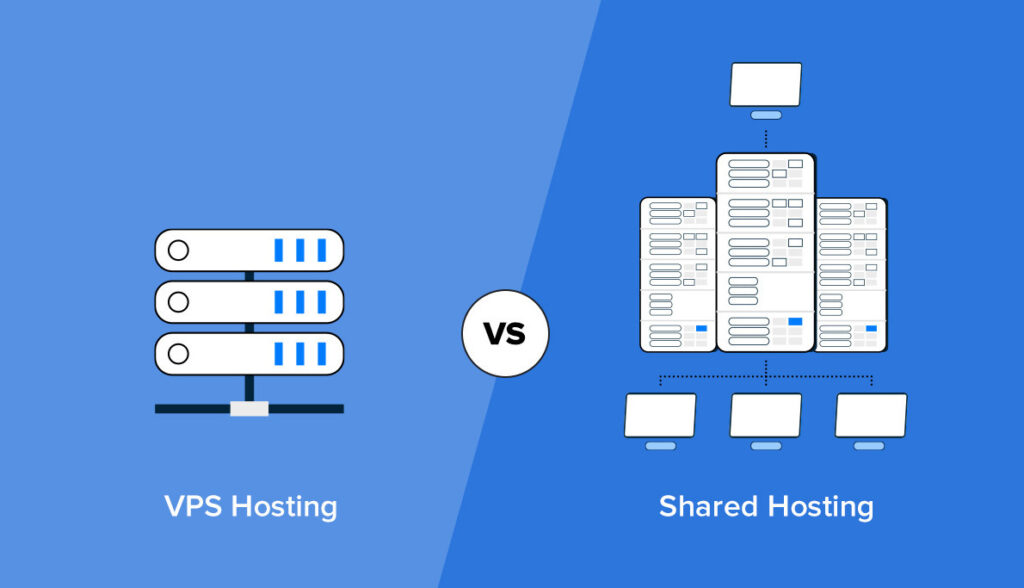
Shared hosting is a type of hosting in which multiple websites share the same physical server and its resources. In this system, the server’s resources such as CPU power, RAM, disk space and bandwidth are divided among all the websites hosted on that server.
Advantages of Shared Hosting
Shared hosting is an attractive option, especially for beginners and small businesses. Its biggest advantage is that it is affordable. Because server costs are shared among many users, monthly hosting fees can be kept quite low. You can usually get service at prices ranging from 3 to 15 dollars per month.
Shared hosting also stands out in terms of ease of use. The hosting provider takes care of all the technical matters, such as server management, security updates and backups. This way, even users without technical knowledge can manage their websites easily. Thanks to user-friendly control panels such as cPanel or Plesk, tasks such as creating email accounts, managing databases and uploading files can be done in a few clicks.
Disadvantages of Shared Hosting
The biggest disadvantage of shared hosting is limited resources. When other websites sharing the same server receive heavy traffic or consume a lot of resources, your website’s performance can also be negatively affected. This can cause your website to slow down or become unreachable, especially during busy periods.
There are also some risks in terms of security. If another website on the same server is exposed to a security vulnerability, this can potentially affect your website as well. Although hosting providers take various security measures, full isolation cannot be achieved due to the nature of a shared environment.
What Is VPS Hosting?
VPS hosting is created by dividing a physical server into multiple virtual servers using virtualization technology. Each VPS has its own operating system, dedicated resources and independent configuration options. This way, it offers much more control and flexibility than shared hosting.
Advantages of VPS Hosting
The most important advantage of VPS hosting is guaranteed resources. The CPU, RAM and disk space allocated to you are entirely yours and are not affected by other users. This makes your website’s performance more predictable and stable. For example, if 2GB of RAM and 2 CPU cores are allocated to you, these resources will always be ready for your use.
In terms of customization and control, VPS hosting is far superior. Because you have root access, you can install any software you want on the server, make custom configurations and optimize the server according to your website’s needs. This feature is ideal for projects with special requirements.
Practical Use Cases for VPS Hosting
VPS hosting is an excellent choice for medium-sized e-commerce sites. For example, an online store that receives 1,000-5,000 visitors a day can offer both fast page loading times and secure payment processing with VPS hosting. VPS hosting should also be preferred for web applications and SaaS projects.
To give a practical example: if you are developing a Node.js-based web application and need to install custom packages, this will not be possible on shared hosting. On VPS hosting, however, you can install all the dependencies you need and run your application under full control.
Performance Comparison
Your website’s performance is critically important for user experience and SEO. The performance differences between the two hosting types are quite pronounced.
Speed and Loading Times
Thanks to its guaranteed resources, VPS hosting offers more consistent and faster loading times. On shared hosting, your website’s loading time can climb to 5-10 seconds, especially during peak hours, while on a well-configured VPS it stays between 1 and 3 seconds. Considering that Google uses page speed as a ranking factor, this difference directly affects your SEO performance.
Resource Usage and Scalability
Shared hosting usually has vague resource limits. Even plans marketed as “unlimited” are actually subject to “fair use” policies. As your website grows and starts consuming more resources, your hosting provider may warn you or suspend your service.
On VPS hosting, on the other hand, resources are clearly defined and you can easily upgrade them when you need to. For example, if you expect your traffic to increase during a campaign period, you can temporarily increase your RAM and CPU resources and return to your old plan when the campaign is over.
Security Comparison
Security is one of the biggest concerns of website owners today. The security differences between the two hosting types can be decisive depending on your business’s needs.
Security on Shared Hosting
On shared hosting, the hosting provider takes basic security measures. However, if the other websites sharing the same server are exposed to a security threat, this can affect your website as well. For example, if a neighboring site suffers a DDoS attack, the server’s overall performance may drop and your site may slow down too.
Security Advantages of VPS Hosting
On VPS hosting, your virtual server is completely isolated from the others. This way, the security problems of neighboring servers do not affect you. In addition, you can configure your own firewall, install custom security software and apply advanced security policies.
To give an example of practical security measures:
1. You can block brute force attacks by installing Fail2ban
2. You can set up a web application firewall with ModSecurity
3. You can configure SSL certificates for free with Let’s Encrypt
4. You can install the ClamAV antivirus for regular security scans
Cost Analysis and Evaluation
Cost is always an important factor when choosing hosting, but deciding based only on the monthly fee can be misleading.
Shared Hosting Costs
Shared hosting plans usually range from 3 to 15 dollars per month. These prices usually include:
– Unlimited or high disk space
– Email accounts
– Free SSL certificate
– Automatic backups
– 24/7 technical support
VPS Hosting Costs
VPS hosting plans, on the other hand, range from 20 to 100 dollars per month. The price is determined by the resources you choose:
– 1-8 GB RAM
– 1-4 CPU cores
– 20-200 GB SSD disk space
– 1-5 TB monthly bandwidth
One point to keep in mind with VPS hosting is that it requires technical knowledge. If you are not experienced in server management, you can choose managed VPS services, but this also increases the cost.
Which Hosting Type Should You Choose in Which Situations?
When Is Shared Hosting Suitable?
Shared hosting is an ideal choice in the following situations:
– For personal blogs or portfolio sites
– For sites that receive fewer than 500-1,000 visitors a day
– For small businesses with a limited budget
– For simple websites that use a standard CMS such as WordPress or Joomla
– For users who have no technical knowledge and don’t want to deal with server management
When Should You Choose VPS Hosting?
VPS hosting will be more suitable in the following situations:
– For websites that receive 5,000+ visitors a day
– For e-commerce sites and platforms that process online payments
– For projects that run custom software or applications
– For those who want to host multiple websites
– For businesses with advanced security requirements
– For web developers and agencies
Conclusion
In conclusion, you should define your needs clearly and make your hosting choice accordingly. The right hosting choice can spare you from unnecessary costs, or from your site crashing under heavy traffic. Cost, performance and needs analysis must be done correctly.